Private Life Applications and Earned Settlement: Current Rules and Announced Changes
What is law now – and what may change
Clients often hear about all of these reforms at once. They do not have the same legal effect.
- In force now. What it covers: Appendix Private Life; Part Suitability (since 11 November 2025). Legal effect: Applies subject to the relevant commencement and transitional provisions.
- Laid, with a future start date. What it covers: B2 English for settlement applications made on or after 26 March 2027 (Statement of Changes HC 1691). Legal effect: Applies only to settlement applications made from that date.
- Announced policy. What it covers: Earned settlement: A Fairer Pathway to Settlement: Government Response (CP 1707), 2 November 2026. Legal effect: None until Immigration Rules are laid and commenced.
- Pending legislation. What it covers: Immigration and Asylum Bill 2026 (Article 8 provisions). Legal effect: None until Royal Assent and commencement.
1. The rules in force now: Appendix Private Life
The private life route has been governed by Appendix Private Life since 20 June 2022. The core residence tests remain in place. However, HC 1691 introduced a higher English-language requirement for settlement applications made on or after 26 March 2027, subject to exemptions.
Who can qualify for permission
- Children under 18 (PL 3.1) who have been continuously resident in the UK for at least seven years, where it would not be reasonable to expect them to leave.
- Young adults aged 18 to 24 (PL 4.1) who arrived in the UK before the age of 18 and have been continuously resident for at least half their life.
- Adults (PL 5.1) who have been continuously resident in the UK for more than 20 years, or who would face very significant obstacles to integration into the country where they would have to live.
For these residence tests, continuous residence may include time spent in the UK with or without permission. It is broken by, among other things, a single absence of more than six months or total absences of 550 days or more (PL 7). These absence limits concern the residence tests for permission. Settlement has separate continuous-residence requirements, including specific rules for UK-born children (PL 15 and PL 15A).
Children born in the UK. A child born in the UK who has lived here continuously since birth for at least seven years may qualify for immediate settlement (PL 13.2), subject to the reasonableness test and the other requirements. Settlement is not automatic.
Article 8 within the Rules (PL 8 and PL 9)
An applicant who does not meet the residence tests is not left with only a request for leave outside the Rules. Under PL 8.1, the decision maker must consider whether refusal would breach Article 8 because it would result in unjustifiably harsh consequences. PL 9.1 allows permission to be granted on that basis. Under PL 8.2, however, the application must still be refused if the applicant falls for refusal under SUI 2.1, SUI 3.1, SUI 4.1 or SUI 5.1 of Part Suitability.
Permission granted under PL 8.1 counts as permission on the private life route for settlement purposes. Leave outside the Rules remains a residual discretion for genuinely exceptional cases that the Rules do not cater for.
On appeal, the Tribunal must also apply the public interest considerations in section 117B of the Nationality, Immigration and Asylum Act 2002. These include giving little weight to private life established while a person’s status was precarious or unlawful.
Suitability
Since 11 November 2025 (Statement of Changes HC 1333), the private life route has been governed by Part Suitability rather than its own suitability rules. Part Suitability includes mandatory refusal grounds for convictions in the UK or overseas resulting in custodial or suspended sentences of at least 12 months, persistent offending and offences causing serious harm. Criminality cases require an individual assessment of the applicable rules and human-rights framework.
Length of permission and the route to settlement
- Adults are normally granted 30 months at a time. They normally need ten years of qualifying permission before settlement. Some earlier permission on other routes can count, subject to the rules (PL 14.3 and PL 14.4).
- Eligible children and young adults can choose 30 or 60 months. This matters financially because the Immigration Health Surcharge is charged for the period requested. They can apply for settlement after five years. Changes from 29 July 2025 extended the five-year route to some young people granted leave under Appendix FM or outside the Rules before 20 June 2022.
- Public funds. Permission is normally subject to a no-recourse-to-public-funds condition. Access may be permitted where the applicant is destitute or faces imminent destitution; where child-welfare considerations outweigh the reasons for imposing or maintaining the restriction, treating the child’s best interests as a primary consideration; or where exceptional circumstances affect the applicant’s income or expenditure (PL 10.5; Home Office public funds guidance).
- Long Residence. Anyone with ten years’ continuous lawful residence should also consider settlement under Appendix Long Residence.
2. How to make a private life application
- Identify the correct limb. Decide whether the applicant relies on the seven-year child test, the young-adult half-life test, more than 20 years’ residence, very significant obstacles, or PL 8.1. Calculate continuous residence to the day.
- Gather evidence for every year of residence. Useful documents include GP and hospital records, school and college records, tenancy agreements, council tax bills, bank statements, HMRC records, and letters from employers, places of worship and community organisations. For very significant obstacles, prepare evidence about the country of return: language, family ties or their absence, health and accommodation.
- Prepare statements and representations. Set out the applicant’s history and ties to the UK. Address the residence tests and, in the alternative, PL 8.1.
- Apply online using the form “Application to remain in the UK on the basis of family life or private life” on GOV.UK. Pay the fee and Immigration Health Surcharge for the period requested, or apply for a fee waiver first if the applicant cannot afford them.
- Special cases. People in immigration detention can raise a private life claim without making a formal paid application. Since HC 584 (September 2026), the same applies to families in the Family Returns Process.
- If refused. Refusal of a human-rights claim normally carries a right of appeal. Certification can remove that right (section 94) or affect whether the appeal can be pursued from within the UK (section 94B). Obtain advice immediately about the decision and applicable deadline.
3. Already laid: B2 English from 26 March 2027
HC 1691 raises the English-language requirement for settlement from B1 to B2 for applications made on or after 26 March 2027, subject to exemptions. This rule is already part of the Immigration Rules. It applies to people already on the private life route who apply for settlement from that date.
4. Announced policy: earned settlement
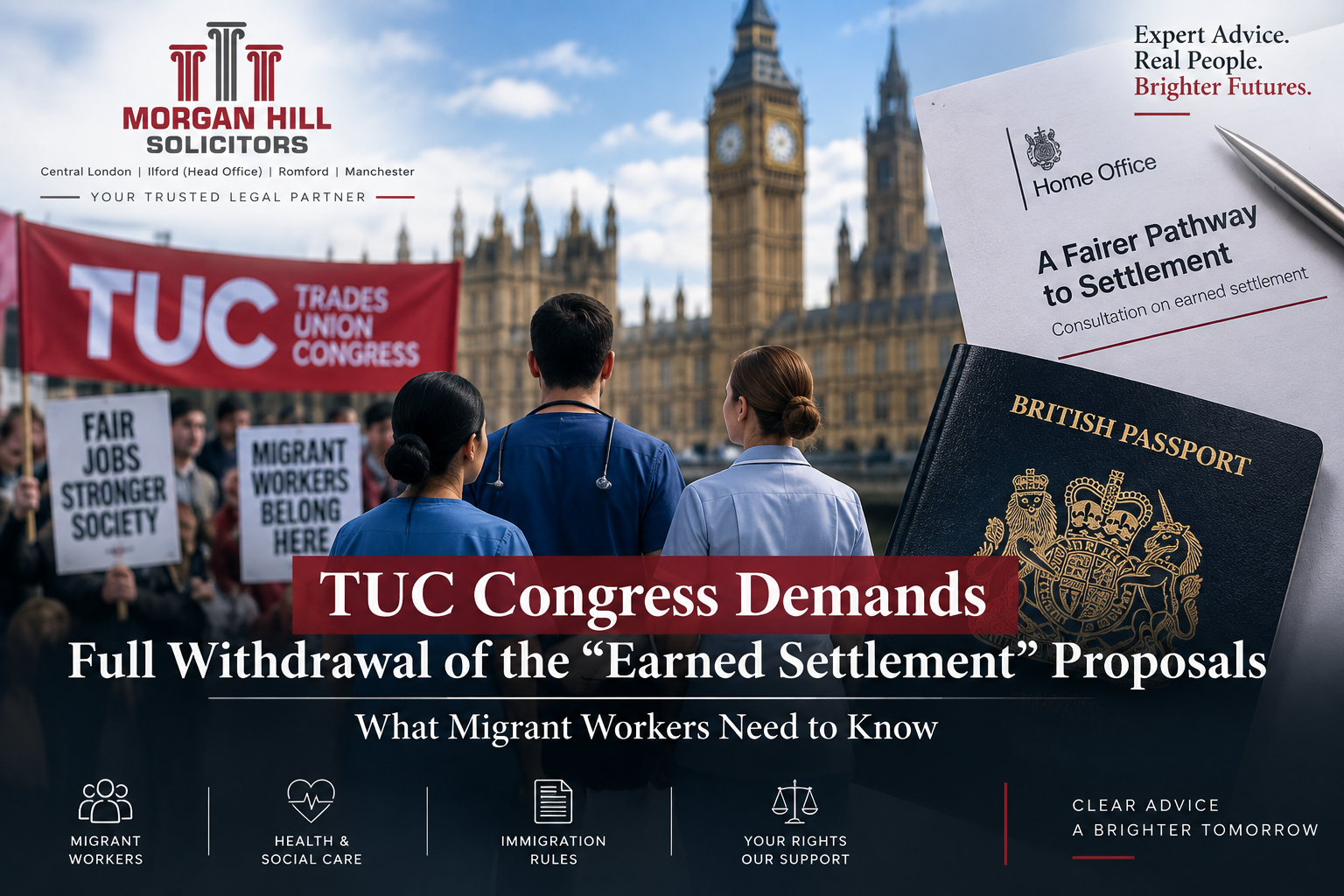
The Home Office consulted on earned settlement between 20 November 2025 and 12 February 2026. It published its response on 2 November 2026 (consultation and response). The response is policy, not law. No Statement of Changes implementing it has been laid.
Timing. In the Commons debate on 2 November 2026, the Home Secretary said the changes would begin to be laid in the December immigration rules and be implemented over the course of 2027. The consultation outcome says further technical guidance will be published before implementation. The precise commencement dates for the new private life settlement requirements have not yet been published.
The main announced changes, compared with the current rules for private life applicants, are:
- Adult qualifying period. Current rules: Normally 10 years of qualifying permission; some earlier permission on other routes can count. Announced earned settlement policy: A 10-year baseline, with longer pathways (ordinarily 20 years) for qualifying immigration breaches, such as overstaying, breach of conditions or deception, or receipt of specified public funds. The public-funds assessment concerns the five years immediately before settlement and is subject to safeguards and exemptions.
- Illegal entry. Current rules: Existing restrictions under PL 12.5–12.6; no general additional ten-year penalty. Announced earned settlement policy: Ordinarily an additional 10 years, subject to safeguards.
- Accelerated 3- or 5-year pathways. Current rules: Not applicable. Announced earned settlement policy: Not available on private life (Article 8) permission. Partners, parents and children of British citizens on qualifying family routes keep a five-year pathway.
- Children and young people. Current rules: 5 years; UK-born children with 7 years may settle immediately. Announced earned settlement policy: The response says existing settlement arrangements will continue for specified children and young people who have grown up in the UK.
- English. Current rules: B1 (B2 for applications from 26 March 2027). Announced earned settlement policy: B2.
- Income. Current rules: No requirement. Announced earned settlement policy: At least £12,571 a year in five of the previous seven years; eligible couples may combine earnings to meet £25,142, subject to conditions.
- Criminality. Current rules: Part Suitability and additional settlement requirements in PL 12. Announced earned settlement policy: Any UK criminal record, including cautions, fines and community sentences, would lead to refusal.
- Government debt. Current rules: Part Suitability and additional settlement requirements in PL 12. Announced earned settlement policy: No outstanding government debt, including NHS charges, tax, National Insurance and Home Office litigation costs.
- Long Residence. Current rules: Available after 10 years’ lawful residence. Announced earned settlement policy: To close; no date or transitional arrangements announced.
Exemptions attach to particular requirements, not to settlement generally. Children under 18 are exempt from the income, government debt, English and Life in the UK requirements. They must still meet the suitability and criminality requirements. People aged 65 or over, and people whose physical or mental condition prevents them from meeting a requirement, are exempt from the relevant requirement only.
The detailed transitional position for private life applicants remains to be confirmed. The Government has rejected a general exemption for people already in the UK, and has announced targeted transitional arrangements only for other groups, such as certain care, health and education workers. The Home Secretary’s statement refers to the rules applying at the settlement decision, while the Government’s news release refers to the point of application. Those formulations differ, so the commencement and saving provisions in the eventual Statement of Changes will be decisive.
5. Pending legislation: the Immigration and Asylum Bill 2026
The Bill has completed its Commons committee stage. The Bill as amended was published on 4 November 2026, and Report stage is the next Commons stage (Parliament’s Bill page). None of it is in force.
Its Article 8 provisions would amend Part 5A of the 2002 Act. As amended (Bill as amended in committee), they would:
- Define family life in statute, with distinct provisions for spouses and partners, genuine and subsisting parental relationships, and relationships between adults involving additional dependency (clause 22).
- Give no weight to private or family life established unlawfully. This would apply to private or family life established while a person is in the UK without leave, with leave obtained by deception, or in serious breach of a condition of their leave. It would replace the current “little weight” rule for unlawful residence (clause 23).
- Extend “little weight” to precarious family life (clause 23(5)). At present this rule applies only to private life.
- Tighten the qualifying-child test. Decision makers and tribunals would have to consider further factors before concluding that the public interest does not require a parent’s removal. A new provision would set out when it would not be reasonable to expect a qualifying child to leave the UK. This is directly relevant to families who rely on a child’s seven years’ residence.
The Home Office’s impact assessment estimates around 11,700 additional Article 8 refusals a year (Commons Library briefing).
6. What this means for a private life claim
- Eligibility for permission. Earned settlement does not change the Appendix Private Life tests. If enacted, the Bill would make Article 8 arguments outside the residence tests harder, particularly where private life was built during unlawful residence.
- Settlement. For adults, the route to settlement is likely to become longer and more demanding. Applicants whose immigration history includes a qualifying breach may face the announced 20-year pathway. The detailed rules will determine which breaches count.
- Children and young people. The Government has said their existing settlement arrangements will continue. How that commitment is implemented will need to be checked when the rules are laid.
7. Practical steps
- If you may already qualify for settlement, obtain a prompt assessment of your eligibility and application timing. Applying before a rule change does not, by itself, guarantee protection from the new requirements; the applicable transitional provisions will determine that.
- If you may qualify for permission now, take advice promptly. Submitting an initial private life application does not itself begin a new period of qualifying permission, although some earlier permission on other routes can count.
- Keep evidence of continuous residence up to date. It matters under both the current and the announced rules.
- Unless exempt, prepare for B2 English if settlement will be applied for on or after 26 March 2027.
- Keep records of earnings and resolve any NHS charges or other government debts.
- Obtain advice about your entitlement to public funds and any potential settlement implications. Do not stop essential support solely because of anticipated reforms.
- Families with children should check the seven-year, half-life and UK-born child provisions now.
Conclusion
Private life applications require careful assessment of residence, personal circumstances and suitability. Those approaching settlement should review their eligibility and evidence promptly. Future reforms may affect their position, but application timing should be based on the rules and transitional provisions that actually apply, rather than an assumed deadline.
Morgan Hill Solicitors is a Lexcel-accredited firm authorised and regulated by the Solicitors Regulation Authority. Our immigration team advises on private life applications, human rights appeals and settlement planning in English, Urdu, Punjabi, Bengali, Hindi and Arabic.
This article is for general information only and does not constitute legal advice. It reflects the Immigration Rules, published Government policy and the Bill as at 11 November 2026. Earned settlement and the Immigration and Asylum Bill 2026 are not yet in force and may change.
Sources
- Immigration Rules: Appendix Private Life (PL 3.1, 4.1, 5.1, 7, 8–9, 10.5, 12.5–12.6, 13.2, 14 and 15)
- Immigration Rules: Part Suitability (SUI 5.1)
- Statement of Changes HC 1691, 5 March 2026 and its Explanatory Memorandum
- Private life caseworker guidance
- Permitting access to public funds (family, private life and Hong Kong BN(O) routes)
- Settlement: family and private life caseworker guidance
- Appeals caseworker guidance: certification under sections 94 and 94B
- Earned settlement consultation and Government response (CP 1707)
- A Fairer Pathway to Settlement: Government response (PDF)
- Hansard: Immigration: Earned Settlement, House of Commons, 2 November 2026
- Home Secretary’s earned settlement statement, 2 November 2026
- Home Office news release, 2 November 2026
- Immigration and Asylum Bill 2026: Parliament Bill page
- Immigration and Asylum Bill as amended in Public Bill Committee
- House of Commons Library briefing CBP-10940